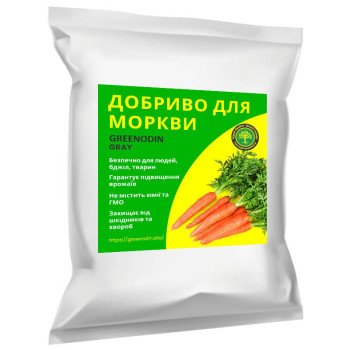
Fertilizers for carrots
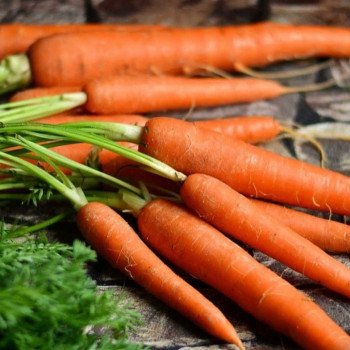
Carrots are successfully grown in almost all soil and climatic zones of Ukraine, as well as worldwide. Carrots are biennial plants, with the first year devoted to the formation of rosettes and taproots, and the second year to flowering and seed production. The root crop in its technical maturity (first year of life) is of great importance for economic use. Therefore, it is crucial to create favorable conditions, including soil treatment, for successful cultivation and obtaining large, high-quality yields. This task is well accomplished by the complex organic fertilizer for carrots GREENODIN GRAY.
The technology for growing carrots
The technology for growing carrots involves several factors listed below, and by adhering to them, you can confidently achieve high results in the form of large, high-quality carrot yields.
Choosing the Site for Carrots
For carrot cultivation, it is best to use well-aerated, highly fertile soils with a light mechanical composition that promotes optimal development of the central taproot. On soils with a heavy mechanical composition, growth is hindered and slowed down, and the taste and other organoleptic qualities of carrot roots deteriorate while fungal diseases become more prevalent. Carrots are not very demanding in terms of soil acidity, and a pH range of 5.0 to 8.0 is suitable for them.
Salinization of soils with a pH below 5.0 has a highly negative impact on seed germination and nutrient uptake. The necessary pH can be easily achieved by applying 25 grams of complex organic fertilizer GREENODIN GRAY per square meter. In terms of topography, fields with a slight slope are preferable. This is because fields with steep slopes can result in seed or seedling washout during intense rainfall.
Soil Preparation for Carrot
For the proper selection of soil cultivation systems, it is important to note that carrots are root vegetables with a deep root system. Therefore, deep soil cultivation is necessary for carrot cultivation. The depth of primary cultivation depends significantly on the thickness of the fertile soil layer and the previous crops. If the previous crops were vegetables or late silage crops, plowing without harrowing is conducted. When using stubble predecessors (legumes, cereals, perennial grasses), harrowing is included in the soil cultivation system, and the depth depends on the weed infestation level. For a high amount of annual weeds, harrowing is performed at a depth of 6-8 cm, and in the presence of couch grass, two discings at a depth of 10-12 cm are applied. Plowing for carrots is done to a depth of 22-25 cm, and according to some data, even up to 28-30 cm. In addition, chiseling across the plow furrow can be carried out at a depth of 40-70 cm (if fertilizers, gypsum, or lime were applied).
Organic fertilizers GREENODIN should be used in the primary soil cultivation system as they improve soil fertility, enhance plant nutrient availability from the early growth and development stages, and improve the quality of the harvested root crops. As a universal solution, it is advisable to use GREENODIN GRAY, which has a pH of 7.0, allowing for effective soil acidity neutralization.
Spring soil cultivation includes moisture conservation and cultivation to a depth of 6-8 cm. On heavily weed-infested fields, cultivation is carried out to the seeding depth before sowing. Prior to sowing, the soil is prepared by harrowing. For long, productive carrots, ridges are formed using a special cultivator. The ridges can be prepared in spring or at the end of autumn. The soil density in the ridge should be such that it does not sink underfoot. The height of the ridge should be 18-30 cm, and the width at the top should be 20 cm.
Carrot varieties and types
Carrot varieties and hybrids: Nantes, Darina, Chantenay, Abaco F1, Flakke, and Berlicum, Narina, Flakke, Argo, Katrin, Boltex, Krasavka, Red Core, Kuroda Chantenay, Campino, Super Muscat, Queen of Autumn, and others. Ultra-early varieties and hybrids of carrots mature in 60 days, while late varieties take 130-140 days to mature. Early varieties are sown for bunching and fresh markets, while late-maturing carrots with high yield and storage quality are grown for storage purposes. The pre-sowing application of GREENODIN provides optimal conditions for seed germination and development.
Predecessors for carrots
Carrots are a demanding crop in terms of crop rotation. They can be grown in field, fodder, and vegetable crop rotations. The recommended rotation interval for carrots is 3-4 years. Continuous or monoculture cultivation of carrots leads to reduced yields, increased susceptibility to diseases and pests, and decreased storability of the roots. The use of GREENODIN allows for monoculture cultivation of carrots without yield losses and helps prevent diseases due to its complex composition and corresponding effects of GREENODIN.
The best predecessors for carrots in field crop rotations are winter crops and leguminous crops. In fodder crop rotations, winter crops for green fodder, maize for green fodder and silage are recommended, while in vegetable crop rotations, zucchini, radish, garlic, legumes, early cabbage, cucumbers, onions, and tomatoes are suitable. Planting carrots near potato, kohlrabi, and corn crops is not recommended. Poor predecessors for carrots include beets, celery, parsley, and potatoes.
To reduce the negative effects of any predecessors in cultivation practices, the application of GREENODIN fertilizer is necessary.
Fertilizers for carrots
Carrot fertilization takes into account the nutrient requirements per unit of yield. Therefore, to produce 1 ton of carrots, the crop requires approximately 2.63 kg of nitrogen, 1.2-1.5 kg of phosphorus, and 4.2-4.8 kg of potassium. The specific application rates of fertilizers can only be determined based on the soil's agrochemical analysis data. The best results in providing carrots with macro and micronutrients are achieved through the application of organic fertilizer GREENODIN, which also contains nitrogen-fixing, potassium-, and phosphorus-producing bacteria, enabling the desired levels of macroelements to be supplied.
Organic fertilizers for carrots
Organic fertilizers are applied as a precursor, as directly applying organic fertilizers to carrots can reduce the marketability of the roots due to increased development of lateral roots. The ideal comprehensive solution for applying organic fertilizers directly to carrots is GREENODIN, the application of which depends on the soil's acidity:
- For neutral and acidic soils with pH <6.0, GREENODIN GRAY organic fertilizer is applied at a rate of 25 g/sq.m (250 kg/ha).
- For soils with alkaline reaction (pH >7.5), GREENODIN BROWN is applied at a rate of 25 g/sq.m (250 kg/ha).
The cumulative nature of GREENODIN, regardless of the type, allows for reducing the maximum application rate from 25 g/sq.m (250 kg/ha) to 8 g/sq.m (80 kg/ha) by the 6th season of application, due to a seasonal reduction of 20%, without any loss in effectiveness. This provides a tremendous economic benefit.
Carrot fertilization
Carrots respond well to the application of micronutrients, such as copper, boron, manganese, and others. Fertilizers can also be applied through irrigation water (fertigation). If nutrient deficiency is observed during the vegetative period, additional fertilization can be done 1.0-1.5 months after carrot emergence. For soil amendment, GREENODIN fertilizers are effective and capable of:
- Stimulating plant growth and increasing yield quantity and quality.
- Enhancing plant adaptation to abiotic and biotic stresses.
- Reducing soil toxicity and suppressing the development of phytopathogens.
- Increasing water retention capacity, allowing up to 40% water savings in irrigation.
- Improving soil fertility.
Carrot sowing
After selecting a well-drained and adequately moistened location with sufficient sunlight and preparing the soil with the help of GREENODIN, carrot seeds are sown directly in their permanent position, as transplanting is not recommended. The recommended soil temperature for carrot sowing is 10-15 degrees Celsius. The sowing depth for carrot seeds is 2.5-3 cm, and on heavy soils, it can be 1.5-2 cm.
Carrot sowing methods
Seed preparation for carrot sowing includes calibration, warming, seed treatment, and more. For sowing, larger seeds (over 2 mm) are used. Air-thermal treatment lasts from 3-5 days to 10-15 days. Carrot seeds are treated with fungicides 2-3 days before sowing. The recommended seeding rate depends on the intended use: for winter sowing - 1.5-2.0 million seeds per hectare, for early production - 0.8-0.9 million seeds per hectare, for fresh market and storage - 1.0-1.4 million seeds per hectare, for processing - 1.0-1.2 million seeds per hectare. The seeding weight for wide-row sowing is 4.5 kg per hectare, for strip sowing - 6 kg per hectare, for wide-strip sowing - 6-8 kg per hectare, and for solid-row sowing - 10 kg per hectare. Sparse plantings for late carrots can result in cracking of the roots.
The optimal sowing time for carrots is determined by soil physical maturity. In terms of the calendar, it falls at the end of March to the beginning of April. For late harvest, carrots are sown 2-3 weeks later (mid-April to the end of May). Winter sowing is done in early November. Summer carrot sowing can also be done after harvesting early crops (early cabbage, lettuce, radish, cucumber, beet). In this case, early varieties and hybrids of carrots are used, and they are sown no earlier than July 20.
It is not recommended to grow carrots as seedlings as young roots tend to grow deformed.
Carrots can be sown using ridge or flatbed, row, or wide-row sowing methods. Depending on the size of the equipment, row spacing is maintained at 30-45 cm, and plant spacing within a row is 2.5-3.0 cm. In the case of row strip sowing, seeds are sown in 4 rows with a distance of 20-30 cm, and subsequent rows are sown at the width of the tractor wheels. Plant spacing within a row is 2.5-3.5 cm.
It is desirable to grow carrots on raised beds. Two rows of seeds are sown on each bed with a row spacing of 65-75 cm and an interval between rows within the row of 6 cm.
After sowing, irrigation should be carried out immediately. The seeds swell and germinate slowly. The first seedlings will appear no earlier than 14-21 days.
Caring for carrot crops
During the vegetative stage of carrots, it is important to provide timely fertilization, weed control, and protection against diseases and pests. The first step in caring for the root crops is thinning the seedlings. Four to six days after sowing, pre-emergence harrowing is carried out, during which herbicides (such as prometryn at a rate of 1.5-2.5 kg/ha or linuron at a rate of 1.5-3 kg/ha) are applied to the carrot plantings. Throughout the growing season, 5-6 inter-row cultivations are performed to remove crusts and improve soil aeration.
Further care for the plantings involves 1-2 inter-row hoeings, as well as combating pests and diseases affecting the root crops.
To control diseases and pests, insecticides and fungicides are commonly used. The most common pests of carrots are carrot flies, aphids, wireworms, leafhoppers, and thrips. Common diseases affecting carrots include powdery mildew, alternaria leaf blight, sclerotinia rot, fusarium rot, rhizoctonia rot, and fruit rot.
To combat diseases, a series of preventive fungicide treatments are planned, which involve applying contact fungicides (copper-based preparations that isolate and destroy the fungus on the leaf surface).
The mobile silicon in GREENODIN provides additional protection against fungal diseases and pests by strengthening plant cells and their cuticles overall. Moreover, the use of powdered silicon component, diatomaceous earth, as a natural insecticide helps reduce the reliance on chemical pesticides.
Irrigation of carrot crops
Irrigation is crucial for obtaining a high-quality carrot harvest. The water requirement for irrigation in the early stages of growth and development can be around 40-50 m3 per hectare, which can be increased to 80 m3 per hectare in subsequent growth periods. The GREENODIN component has high water absorption, which helps retain water on a microscale. Incorporating GREENODIN into the soil can assist in retaining moisture, reducing the need for irrigation, and promoting plant growth. Additionally, GREENODIN helps retain moisture in the soil during rainfall, reducing soil erosion and providing it with nutrients.
Carrot harvesting
Carrots can be harvested when they reach the desired size and the color of the foliage changes. Harvesting can be done manually or mechanically. About 2-3 weeks before harvesting, irrigation is completely stopped to avoid fruit cracking during the collection. For early carrots and bunching production, the period without irrigation is significantly shorter. Mechanized harvesting utilizes modified potato and beet harvesters, various diggers, and special carrot harvesters (KKG-1.4). The use of GREENODIN organic fertilizers containing silicon enhances the resistance of carrot root crops to mechanical damage, thus improving their storage quality.
Carrot crop residues
GREENODIN organic fertilizers contain agronomically beneficial microorganisms that are highly effective in decomposing plant residues as they act as decomposers. Furthermore, these microorganisms suppress the pathogenic form, thereby improving soil health.
Beneficial microorganisms present in the fertilizer, such as bacteria and fungi, can help increase soil fertility and enhance plant quality. These microorganisms can decompose organic matter and convert it into humus, which serves as a nutrient base for plants.
Moreover, GREENODIN organic fertilizers contain significant amounts of macro and micronutrients, which significantly improve the development and yield of carrot plants. GREENODIN fertilizers can enhance the effectiveness of soil cultivation and promote healthy plant growth.