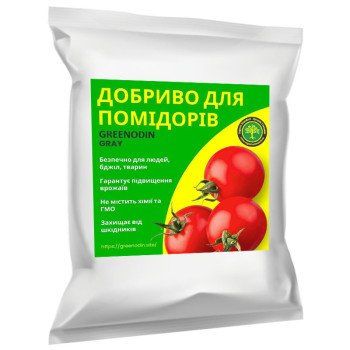
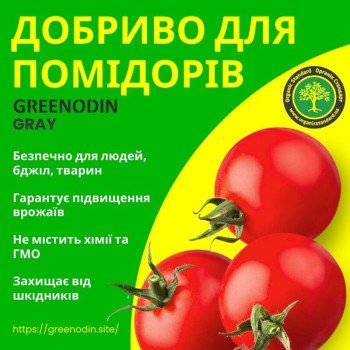
Fertilizers for tomatoes
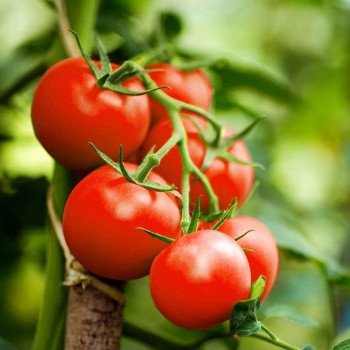
Tomatoes are one of the most common vegetable crops of the Solanaceae family, which grows perfectly with the use of complex organic fertilizer for tomatoes GREENODIN GRAY. They can be grown in practically all soil and climatic zones of Ukraine, both through seedlings and direct sowing.
Tomato cultivation technology
To realize the genetic potential of yield and obtain high-quality produce, it is important to adhere to modern adaptive cultivation techniques. Additionally, there is great attention given to organic production both in Ukraine and worldwide, which requires the use of organic fertilizers, soil fertility potential, beneficial soil microflora, and so on.
Site selection for tomatoes
For tomato cultivation, it is best to choose well-warmed and well-lit areas that are protected from strong winds. The soil should be well-supplied with nutrients and have a neutral or near-neutral pH.
Soil preparation for tomatoes
The soil preparation system depends on the preceding crop and includes stubble shaving and plowing. Stubble shaving should be done to a depth of 6-8 cm after harvesting the preceding crop. After weed emergence, a second stubble shaving should be done to a depth of 12-14 cm. Fertilizers are applied during the stubble shaving as part of the basic fertilization. To improve soil fertility and tomato yield, organo-mineral fertilizer GREENODIN GRAY is used. If there is a lack of moisture between the first and second stubble shaving, irrigation should be carried out. Plowing is done to a depth of 22-25 cm, or 27-30 cm in chernozem soils.
In the Forest-Steppe and Steppe zones, minimal soil tillage is recommended for tomato cultivation, which includes 2-3 cultivations and autumn chiseling to a depth of 16-18 cm.
In fields heavily infested with root sprouting and rhizomatous weeds, a three-stage stubble shaving is employed using disc stubble shavers at depths of 8-10 cm, 10-12 cm, and 14-16 cm, with a time interval of 10-12 days. Deep plowing is then conducted.
Tomato varieties
For intensive cultivation techniques, it is best to use hybrid varieties, which are more productive and better adapted to stressful growing conditions. The following varieties are well suited for greenhouse cultivation: Geisha, Fairy's Gift, Andromeda, Beak of the Eagle, Pink Angel, Pink Pearl, Fatalist, and others. For canning purposes, Banana Legs, Raja, Roma Granny, Auria, Cherry, and others are recommended. For open-field cultivation, Kibic, Belli F1, Bobcat F1, Pink Flamingo, Red Icicle, Oxheart, Gina, Lodgein, Tornado F1, Imperia F1, Samurai, Yakiman F1, Prisadibny, Pridniprovsky, and others are suitable varieties.
Tomato predecessors
Tomatoes are sensitive to their predecessors. The best predecessors are cereal crops, peas, early cabbage, cucumbers, onions, pumpkins, zucchini, cabbage, and forage beans. The recommended rotation period is 3-4 years. For tomato seedlings, the best predecessors are onions, cucumbers, a layer of perennial grass, cabbage, table root crops, garden crops, carrots, legumes, and post-harvest crops. Poor predecessors for tomatoes are potatoes, eggplants, peppers, and other solanaceous crops. To improve the decomposition of post-harvest residues, balance nutrient elements, and enhance soil fertility after any predecessors, it is recommended to use organo-mineral fertilizer GREENODIN.
Fertilization for tomatoes
Starting from the stage of 2-3 true leaves, plants can be fertilized with nutrient elements. If the soil (substrate) is well-supplied with nutrients, fertilization can be done 30-32 days after seedling emergence. For better hardening and stress tolerance during transplanting, it is necessary to provide plants with a balanced supply of nutrients. Starting from the 4th day after transplanting seedlings into the open field, fertilization can be carried out to promote better root development. Tomatoes require 3.3 kg of nitrogen, 1.3 kg of phosphorus, 4.53 kg of potassium, 4.4 kg of calcium, and 0.8 kg of magnesium per ton of production. Mineral fertilizers are applied as the main fertilizer and during the tomato's vegetative growth. It is better to use complex organic fertilizer GREENODIN GRAY for fertilizing and feeding tomatoes.
Fertilizing tomatoes
The first fertilization with nitrogen and potassium fertilizers is done at the stage of initial fruit set on the first flower cluster. The second fertilization is done during the period of fruit enlargement, and the third is done during the ripening period of the harvest. It should be noted that the nitrogen fertilizer rate is reduced during the third fertilization, and in case of excessive vegetative growth, nitrogen fertilization is not conducted at all.
Fertilizers for tomatoes
The application of organic fertilizers at a rate of 20-25 t/ha is done before plowing. The maximum rate of organic fertilizers for tomatoes can reach 80-100 t/ha. In the fertilizer system for tomatoes, the organo-mineral fertilizer GREENODIN GRAY shows high efficiency at all application stages. It contains a meliorant, recultivator based on leonardite or sapropel, and silicon-containing natural minerals. This fertilizer is completely safe for humans, bees, and animals.
GREENODIN GRAY organic fertilizer can be effectively used for growing tomatoes in both open fields and greenhouses. It contains a complex of microelements and macroelements (pH 7-8, 70% dry matter, 150 mg/100 g soil of nitrogen, 150 mg/100 g soil of phosphorus, and 200 mg/100 g soil of potassium), as well as organic nutrients, which provide balanced nutrition for plants and improve the agronomical properties of the soil. The humic and fulvic acids in this fertilizer enhance the utilization of nutrients and water by plants from the soil.
The application of GREENODIN GRAY increases tomato yield by 65%, improves resistance to pests and diseases, reduces water usage by 30%, enhances soil fertility, promotes the development of beneficial soil microflora, and improves root system growth and development in tomatoes.
The presence of silicon in this fertilizer contributes to increased plant resistance to pests, drought, and low temperatures.
An ideal comprehensive solution for the application of organic fertilizers directly to tomatoes is GREENODIN, and its application depends on soil acidity:
- For neutral and acidic soils with a pH of <6.0, GREENODIN GRAY organic fertilizer is applied at a rate of 25 g/sq.m (250 kg/ha).
- For alkaline soils with a pH of >7.5, GREENODIN BROWN is applied at a rate of 25 g/sq.m (250 kg/ha).
The cumulative nature of the GREENODIN preparation allows reducing the maximum application rate from 25 g/sq.m (250 kg/ha) to 8 g/sq.m (80 kg/ha) for the 6th season of application, with a 20% reduction each season, without any loss in effectiveness, resulting in significant economic benefits.
Thanks to the beneficial microflora present in GREENODIN GRAY fertilizer (nitrogen-fixing, phosphorus- and potassium-mobilizing, and silicon-modifying bacteria), the absorption of even inaccessible nutrients from the soil is improved, and the presence of fungal spores additionally suppresses pathogenic microflora.
Tomato Sowing for Seedlings. Growing Tomatoes from Seeds
For sowing, seeds with high germination rates are used, which may be coated, pelleted, or treated with fungicides. To grow tomatoes from seeds, wide-row and strip planting methods are used. The wide-row planting scheme can be 60-40-50 cm, 70-30 cm, 90-25 cm, or 140-20 cm, while the double-row strip planting scheme is (50+90) x 30 cm or (60+120) x 20 cm. Tomato seeds are sown at a soil temperature of 8-10 cm deep within the range of +10-12°C. The sowing dates may vary each year depending on the temperature and soil moisture. The recommended seed sowing rate is determined by the plant height of each variety, typically 2.5-3 kg per hectare for indeterminate varieties and 3-4 kg per hectare for determinate and dwarf varieties. The seeds are covered with soil to a depth of 3-4 cm. The plant density is determined by the ripening group of the varieties, ranging from 90-100 thousand plants per hectare for early-maturing, dwarf varieties to 70-90 thousand plants per hectare for mid-season varieties and 55-70 thousand plants per hectare for late-maturing varieties.
Planting Tomato Seedlings
Seedlings are transplanted into open ground during a period when there is no risk of spring frost. The planting scheme includes a row width of 60-70 cm and a distance of 30-50 cm between plants, depending on their height. To obtain seedlings, seeds are sown 45-70 days before transplanting them into the ground, considering that the seed germination period is 7-12 days. In the calendar plan, this corresponds to the end of February or the beginning of March, so that the seedlings are ready in May. Seeds for seedlings are sown into specially prepared substrates (a mixture of peat, manure components, and other materials for loosening). The seeds are planted no more than 1 cm deep in the soil. After sowing, the plantings are covered with glass or plastic and placed in an environment with a temperature of +15-25°C. Additional lighting (10-12 hours) can be used during the seedling stage. When the first true leaf appears, or about 12-16 days after germination, the seedlings are pricked out. Weak and diseased plants are removed. It is important to hold the seedlings by their cotyledons rather than the stem during this process. The pricked seedlings are watered. About 10-12 days before transplanting, hardening off is performed, which involves exposing the plants to short periods of slightly higher temperatures.
Tomato Plant Care
Caring for tomatoes includes plant staking, combating pests (such as spider mites, wireworms, cabbage worms, Colorado beetles, etc.), diseases (such as Septoria leaf spot, late blight, brown spot, blossom end rot, tobacco mosaic virus, etc.), removing suckers, and soil loosening. To combat diseases, a 1% Bordeaux mixture solution is used after transplanting the tomato seedlings, while insecticides are used for pest control. Care for the plantings begins with inter-row cultivation to a depth of 6-8 cm. The number of inter-row cultivations depends on the physical condition of the soil and weed infestation and can range from 2-3 up to 4-8 times. The final soil loosening is done before the plants close together in the rows, to a depth of 20-25 cm.
Tomato Irrigation
The first watering of seedlings should be done before the appearance of the first leaf, and after the emergence of the first leaves, watering should be done once a week. Once 4-5 leaves have appeared, watering should be done every 3-4 days.
Tomato Harvesting
Tomatoes should be harvested when they reach a pink level of ripeness. Harvesting should be done before the first frost. Mechanized and manual harvesting methods are used for tomato harvesting. Some industrial tomato harvesters include TAKI-18M, SKT-2A, C/RP 150, and others.
Plant remains of tomatoes
After harvesting the main produce (the fruits), there are plant residues such as stems and root systems left in the fields. The use of organic fertilizers like GREENODIN for field treatment after harvest allows for the suppression of pathogenic microflora and enhances the decomposition of plant residues through beneficial microorganisms. These microorganisms break down the organic residues into humus, which serves as a nutrient-rich base for plants.
It's worth noting that GREENODIN organic fertilizers contain a wide range of macro and micronutrients compared to synthetic mineral fertilizers, which have a more limited composition. This significantly improves plant growth, development, and crop yield.
Additionally, if the soil contains pathogenic microorganisms such as Phytophthora or other diseases, GREENODIN fertilizers can help reduce their population and prevent their spread. Therefore, GREENODIN organic fertilizers can enhance soil treatment effectiveness and promote healthy plant growth.
Tomato storage
Tomatoes are stored in special storage facilities or refrigeration chambers with reduced oxygen concentration and increased carbon dioxide concentration. Green tomatoes (unripe) are stored at temperatures of +21-28°C and relative air humidity of 90-95% for 21-28 days, while ripe fruits are stored at temperatures of +8-11°C and relative air humidity of 90-95% for 7-14 days.
The use of GREENODIN fertilizers, which contain not only macro and micronutrients but also active silicon, in the cultivation system helps to extend the shelf life of the produce and limits the spread of pathogens.