Fertilizers for cucumbers
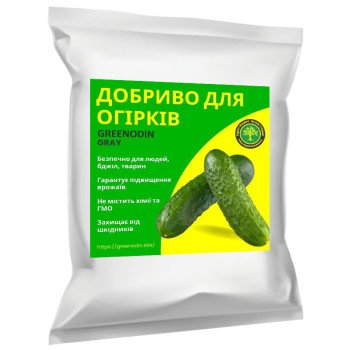
The application of the granulated organic fertilizer for cucumbers GREENODIN GRAY is an ideal and versatile method for growing cucumbers. This fertilizer promotes healthy cucumber growth, restores fertility, and enriches the soil, improving its structure. Due to its composition and multiple functions, GREENODIN GRAY is a comprehensive fertilizer and a complete green fertilizer for cucumbers. In simple terms, the biological fertilizer GREENODIN GRAY consists of an organic component in the form of leonardite and/or peat, a mineral component in the form of silicon-containing natural minerals like diatomite or zeolite. This mixture is activated by organic polycarbosilicic acids and agronomically beneficial microorganisms.
GREENODIN GRAY is effective for fertilizing cucumbers both in open ground and in greenhouses. The fertilizer for cucumbers in greenhouses differs only in the place of application, using the same norms and methods. It is recommended to apply 25 grams per square meter for the basal application or per linear meter for planting in rows. For localized application, apply 25 grams per plant.
By using the GREENODIN GRAY complex fertilizer for cucumbers, both for fertilization and top-dressing, you are guaranteed to achieve:
- Increased soil fertility with improved agronomic capabilities and biological indicators.
- Reduced soil toxicity and inhibition of the development of phytopathogenic microorganisms.
- Enhanced plant viability and increased resistance to diseases.
- Stimulation of plant growth and development.
- Reduced water consumption for irrigation by up to 30%.
- Decreased application rates by 20% annually.
- Reduced use of agrochemicals, potentially eliminating their use altogether.
- Transition to organic farming practices.
- Increased qualitative value and market price of organically grown cucumbers.
Soil for Cucumbers
The optimal soil acidity for cucumbers is within the range of neutral pH 7.0, starting from slightly acidic pH 6.5. This range provides the best conditions for the growth and development of cucumbers.
If the soil pH is too low (acidic) and below pH 6.5, it is recommended to add GREENODIN GRAY to increase the pH, reduce soil acidity, and bring it closer to the optimal level.
If the soil pH is too high (alkaline) and above pH 7.0, it is recommended to add GREENODIN BROWN to lower the pH and increase the soil acidity, approaching the optimal range.
Prior to planting cucumbers, it is recommended to conduct a soil pH test, as advised in the article "Determining Soil Acidity".
It is important to note that cucumbers can tolerate slight deviations from the optimal pH, but extreme values and deviations adversely affect nutrient uptake by cucumbers and lead to growth and development issues. Therefore, maintaining optimal soil pH is a crucial aspect of successful cucumber cultivation.
Cucumbers prefer loose, fertile soil with good drainage capacity, rich in organic matter, having a pH range of 6.5-7.0, and being adequately moist but not waterlogged.
«GREENODIN garden soil» is a good option for growing cucumbers as it has a pH of 7.0 and can be supplemented with sand or perlite to improve soil drainage and provide sufficient nutrition and moisture for the plants.
In addition to soil, it is also important to provide cucumbers with good lighting, warmth, and protection from cold drafts.
Planting Cucumbers
Planting cucumbers in open ground involves selecting a sunny spot in your garden or vegetable patch where cucumbers will receive full daylight. They thrive in warmth, so choose a location with a good thermal regime.
Prepare the soil as listed under "Soil for Cucumbers" by opening the beds, digging the soil, removing weeds, with an appropriate application of fertilizer for cucumbers GREENODIN GRAY, 25 grams per linear meter per row.
Cucumbers can be grown from seeds or using seedlings. If you are using seeds, sow them at a depth of about 1-2 cm, following the recommendations provided on the seed packet. If you are using seedlings, transplant them into the beds, maintaining the recommended spacing between plants (usually around 30-45 cm).
What is the distance for planting cucumbers? The distance depends on their variety, type, and the available space you have:
- For vertical cultivation of cucumbers (using supports/trellis): between rows: 60-90 cm, and between plants in a row: 30-45 cm.
- For horizontal cultivation of cucumbers on the ground or in a bed: between rows: 90-120 cm, and between plants in a row: 45-60 cm.
Next to the sown seeds or transplanted seedlings, set up supports such as grids or trellises to help them climb and support the fruits, as cucumbers are vines.
These recommendations will allow cucumbers to have enough space for growth, access to sunlight, and good air circulation between plants.
After planting in open or enclosed soil, follow the rules of maintaining soil moisture by clearing weeds and pests.
Planting cucumbers in a greenhouse should consider the mentioned factors for vertical cultivation.
Planting cucumbers in May assumes that it is already a warmer time of the year, and the soil is beginning to warm up. Make sure that the soil has reached a temperature of around 15-20 °C. Cold soil will slow down the growth of cucumbers and lead to problems. Plant cucumber seeds or seedlings at a depth of about 1-2 cm in the soil, while observing the recommended distances between plants.
Planting cucumbers in July means it is a hotter time of the year, so provide protection for cucumbers from direct sunlight and excessive drought. Prepare the soil, plant the seeds or seedlings at the appropriate distances as described above, and regularly water the plants, especially during dry periods, to ensure an adequate amount of moisture.
Additional protection from extreme heat may be necessary, such as using shade or sunshade nets.
Growing Cucumbers
Growing cucumbers requires fertile soil with good drainage. The soil should be loose and rich in organic matter. Prepare the beds, till the soil, and remove any weeds.
Cucumbers need regular watering. Keep the soil moist, especially during hot weather. Water in the morning or evening to avoid moisture evaporation. Avoid overwatering the soil to prevent root rot.
Cucumbers are vines and require support for vertical growth. Set up supports such as trellises or stakes next to the plants to help them climb. Regularly remove weeds to prevent nutrient competition.
Regular fertilization of cucumbers will help them develop and produce fruit. Use organic fertilizers for cucumbers GREENODIN GRAY, which are rich in macro and micronutrients for outdoor cultivation. For greenhouse cucumber cultivation, use enriched artificial soil like «GREENODIN garden soil», specially formulated for cucumbers.
Cucumber Fertilization
Fertilizing cucumbers will provide them with essential nutrients and promote their growth and development. Organic fertilizers for cucumbers GREENODIN GRAY are an ideal choice, as they provide a pH level of 6.5-7.0 and supply macro and micronutrients to improve soil fertility and provide the necessary nutrition to the plants. Place the organic fertilizer around the plants and carefully incorporate it into the soil.
Regularly fertilize cucumbers throughout their growing period by applying the recommended fertilizers along with watering. The first fertilization for cucumbers is recommended 2-3 weeks after planting, and continue every 2-3 weeks thereafter. Monitor the condition of the cucumbers and their response to fertilization. If you notice signs of nutrient deficiency (such as yellowing leaves), apply the appropriate fertilizer.
Remember that fertilization is a supplement to proper soil preparation and regular watering. Consider the individual needs and recommendations for your specific cucumber variety and local conditions to achieve good harvests.