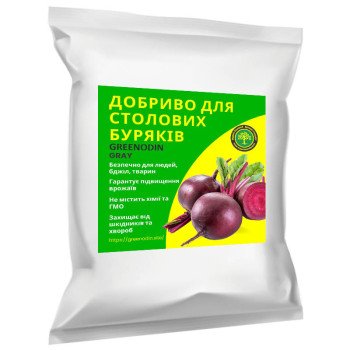
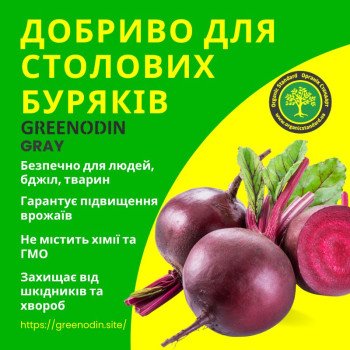
Fertilizers for table beets
Table beets, also known as red beets or simply beets, are a popular root vegetable known for their sweet flavor and vibrant color. Successful cultivation of table beets is guaranteed through the use of organic fertilizer GREENODIN GRAY, which provides the necessary nutrients without harming the beets themselves, the environment or the gardener directly.
Growing table beets
To successfully cultivate table beets with GREENODIN GRAY organomineral fertilizer, follow the steps below.
Soil for table beets
Amend the soil with organic matter such as compost to improve its texture and fertility. Make sure the soil is well drained and has an acidity of up to pH 7.0.
Choosing fertilizer for beets
The ideal comprehensive solution for applying organic fertilizers directly to beets is GREENODIN GRAY, the application of which depends on soil parameters, including acidity, structure and organic content, but the maximum application rate is 25 g/m2 or 250 kg/ha. The cumulative nature fertilizers for table beets GREENODIN GRAY, of any type of soil, allows you to reduce the maximum application rate of 25 g/m2 (250 kg/ha) to 8 g/m2 (80 kg/ha) for the 6th season of application of the drug, due to a seasonal reduction of 20% , without loss in productivity, which gives a colossal economic effect.
Planting beetroot
Sow beet seeds directly into the soil about a half-inch deep and 2 inches apart. Once seedlings emerge, thin them out to ensure proper spacing. If you are planting with seedlings, do not forget to use GREENODIN GARDEN SOIL seedling substrate or enrich your substrate with fertilizer for table beets GREENODIN GRAY, applying 25 grams per liter of substrate. Such enrichment will ensure friendly shoots and sustainable germination of red beet seeds.
Watering beets
Keep the soil constantly moist, but avoid overwatering as this can cause root rot. Regular watering is essential for healthy growth.
Watering beets with salt water
To repel pests and to further increase the taste of the root crop, as well as to disinfect the soil, it is advisable to water the beets with salt water, a maximum of 3 times during the entire season.
The first time is when the beets throw out 5 leaves, the second time is when the upper part of the root crop appears on the soil, and the third time is a week before harvesting. Time to water with saline solution: early morning or evening after sunset, or throughout the day if the day is cloudy, ensuring that the beets are not exposed to sunlight when watering with saline solution. Composition and preparation of the solution: dissolve 1 tbsp in 1 liter of hot water a spoonful of table salt (table salt). The use of iodized salt is excluded. Dilute the prepared solution in a bucket of cool water. If the base soil for growing beets is acidic, then it is advisable to add 0.5 liters of wood ash and mix thoroughly. Treat the plants with the resulting solution directly leaf by leaf.
Beet care
Fertilizer for table beets GREENODIN GRAY strengthens the natural defense of table beets against pests and diseases. At the same time, monitor the plants for pests and remove them if present.
Be sure to remove any weeds germinating near the beets.
Harvest
Harvesting beets depending on the variety:
- Early ripening beet varieties usually ripen 2-3 months after planting. Harvesting can begin in July or early August.
- Mid-season varieties ripen approximately 3-4 months after planting. The harvest can be harvested in late August or early September.
- Late-ripening varieties ripen 4-5 months after planting. Harvesting takes place at the end of September or mid-October.
How to determine whether beets are ready for harvest?
Beets are ready to harvest when the roots have reached the desired size for a given variety, have acquired a bright color and a thick skin. At the same time, beet leaves may begin to turn yellow and fall off, which is also a sign of readiness for harvest.
When harvesting, it is advisable to use a fork, carefully digging up the root crops so as not to damage them. After harvesting, cut off the remaining foliage, leaving about 1-2 cm of stem, and clean the roots from the soil. Allow root vegetables to dry before storing to avoid rotting. Beets are best stored in a cool, dry, well-ventilated place. Silicon from GREENODIN GRAY absorbed by beets will ensure long-term storage of beets, enhancing their taste.
Conclusion
Using Fertilizer for table beets GREENODIN GRAY as an organic fertilizer significantly increases the success of table beet cultivation.
It provides essential nutrients, improves soil health and promotes sustainable farming practices.
By following the recommended methods and dosage, growers can enjoy a bountiful harvest of delicious, high quality table beets.
Go to our product catalog and choose GREENODIN organomineral fertilizers for other crops.