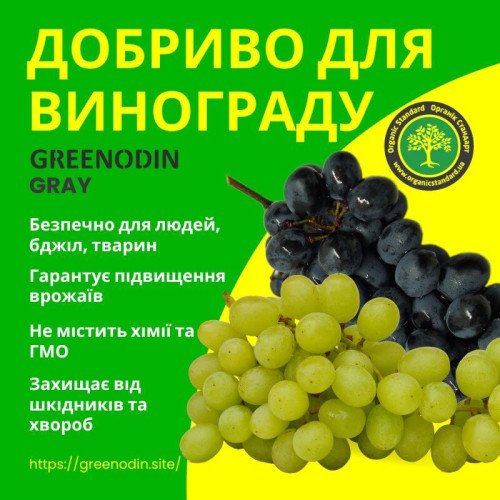
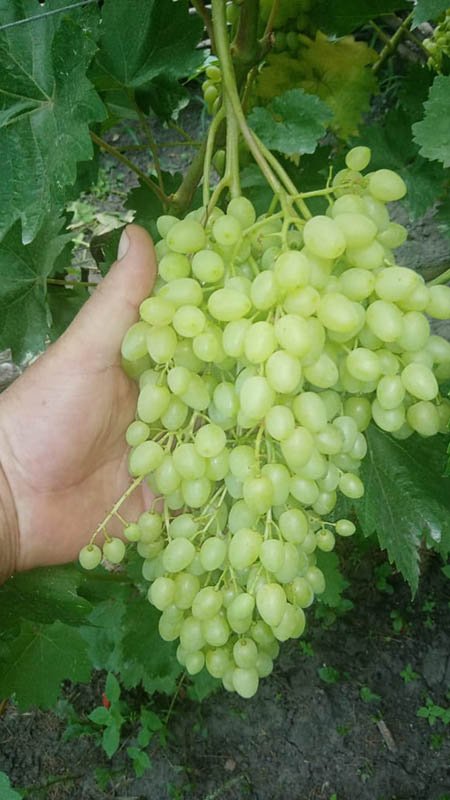
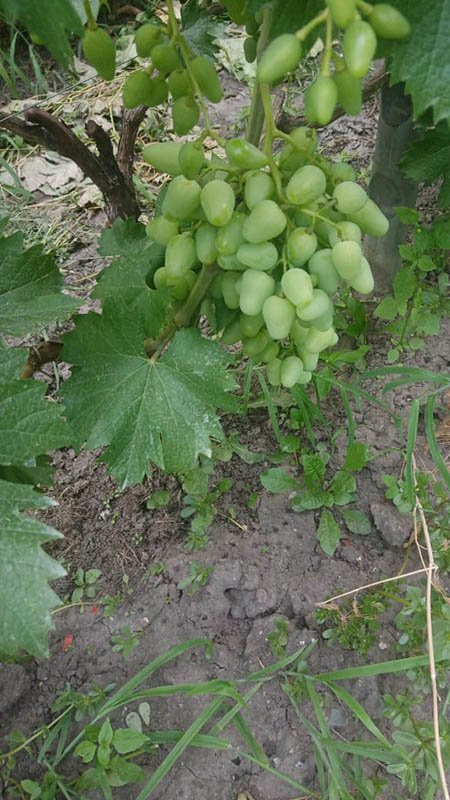
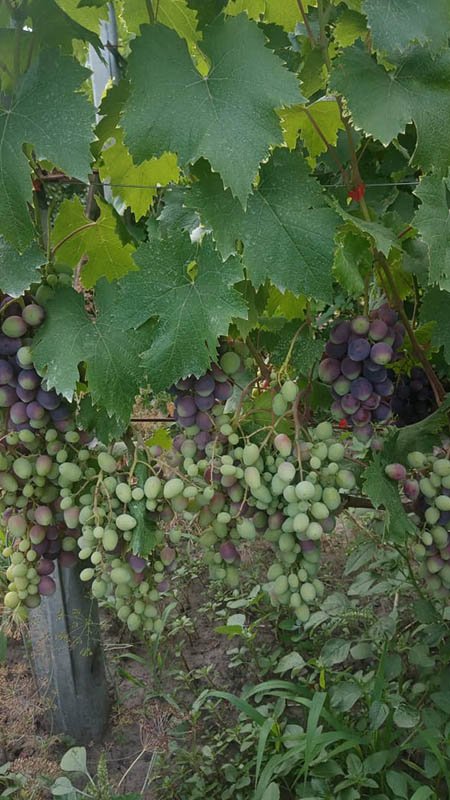
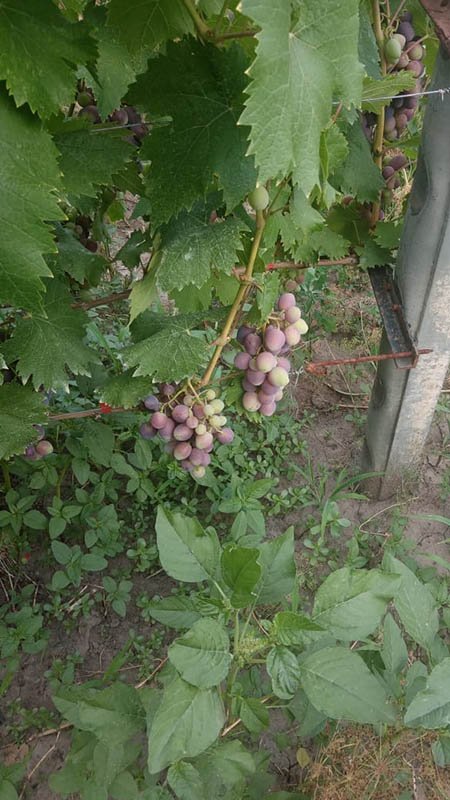
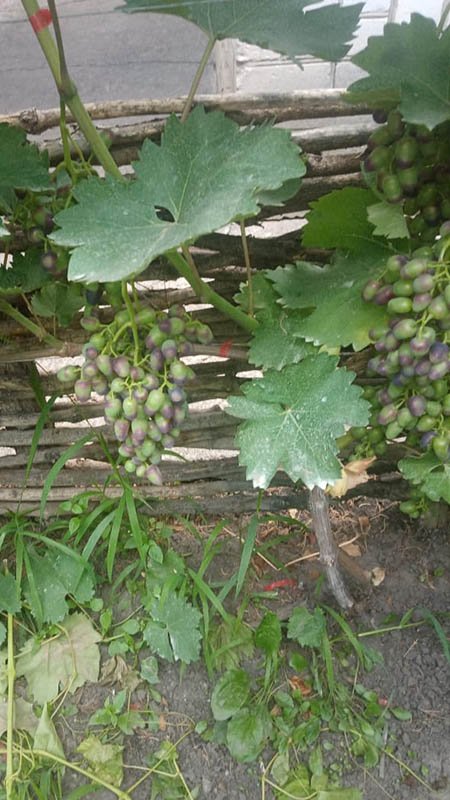
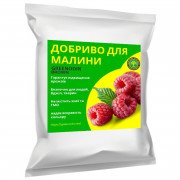
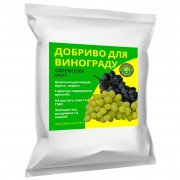
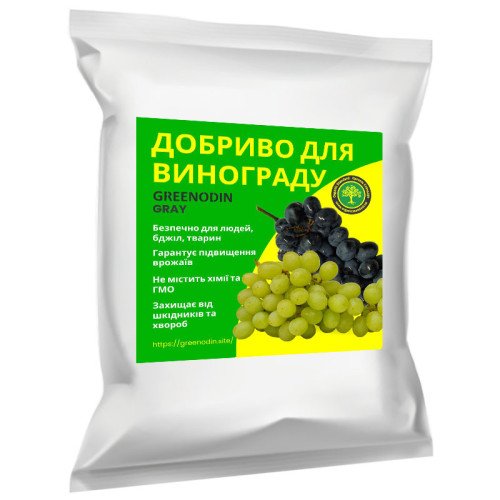
Fertilizers for grapes GREENODIN GRAY granules
Available Options
Organic fertilizer for grapes GREENODIN GRAY granules recultivate is an innovative complex organic granular fertilizer, recultivate, ameliorant created on the basis of leonardite and silicon-containing natural minerals, with an average content of organic matter, degree of mineralization.
Fertilizer for grapes GREENODIN GRAY is absolutely safe for people, bees, animals.
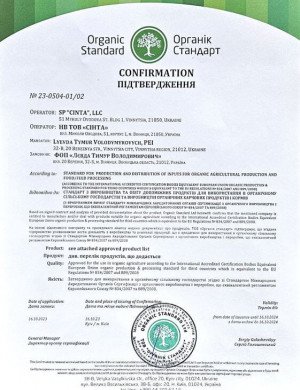
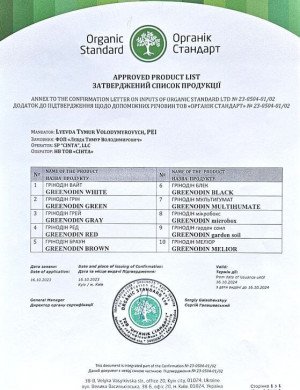
Organic granulated grapes fertilizer GREENODIN GRAY is developed according to international environmental requirements and meets European standards No. 834/2007; No. 889/2008, and is certified Organic Standart.
The advantages of using a complex organic granular fertilizer for grapes GREENODIN GRAY
The complex organomineral fertilizer for grapes GREENODIN GRAY provides:
- absorption of the necessary amount of nitrogen, which is responsible for the growth and development of grapes. The more healthy green leaves the grapes have in the spring, the richer the crop will be by fall
- increases sugar content, size of berries and bunches of grapes
- provides excellent taste qualities of fruits
- natural nutrition with all necessary macro- and micronutrients
- soil improvement
- development of a powerful root system of the vine
It is impossible oversaturation of plants with fertilizer for grapes GREENODIN GRAY, as in the case of mineral (chemical) fertilizers, since GREENODIN GRAY is an organic fertilizer, which provides a natural and balanced plant nutrition.
Read more about the benefits you get, using organic granular fertilizer for grapes GREENODIN GRAY
| Technical | |
| Fertiliser type | complex, 100% organic fertilizer of prolonged action with live bacteria |
| Form | Granulated |
| Manufacturer country | Ukraine |
| Country of brand registration | Ukraine |
| Application period | Spring, summer, fall, winter |
| Pack | Polyethylene transparent or opaque |
| Certificate | Organic Standard, complies with EU regulations No. 834/2007 and No. 889/2008 |
| Composition | 1)Natural mineral components - leonardite enriched with humic and fulvic acids. This component provides natural nutrition for plants and beneficial bacteria 2) Amorphous silicon - provides the soil with the right pH acidity. It accumulates and structures water, which does not evaporate even at high temperatures, but nourishes the roots in a capillary way 3) Macroelements and trace elements necessary for plant growth 4) Useful bacteria. Provide all the nutrition the plant needs. They start the processes of humus formation and increase soil fertility. 5) Mass fraction of organic matter (C) % - not less than 50-55 6) Nitrogen content (N), mg/100 g - not less than 150 7) Phosphorus content (P2O5), mg/100 g - not less than 150 8) Potassium content (K), mg/100 g - not less than 200 |
| Consumption rate | Since the effect of fertilizers is prolonged, the application rate is reduced by 20% each year: 1st year (2 times a year): at planting: 25 g per 1 liter of soil or substrate growing conifer, at a height of up to 1 m: 50 g per plant growing conifer, at a height of 1-2 m: 100 g per plant growing conifer, at a height of 2-3 m: 150 g per plant growing conifer, at a height of 3-4 m: 200 g per plant 2 - 4 years: constantly reduce by 20% 5th year (2 times a year) - 8 ml (8 g) of 1 liter of soil or substrate, and respectively: 16g, 32g, 40g, 64g from plant growth Further, the application rate does not change |
| Application rate | 2 times a year |
| Application method | Root. Spread and water. Can be covered with soil |
| Biological action | 1) Normalize soil acidity to the levels required by the plant 2) Suppresses pathogenic soil flora 3) Creates favorable environment for natural humus formation and development of beneficial bacteria 4) Improves soil quality 5) Reduces phytotoxicity of soil 6) Strengthens the immune system 7) It has a prolonged effect, which allows to reduce the annual application rate by 20%. 8) Repels pests 9) Increases resistance to stress 10) Frost resistance of plants is formed 11) Increases drought and heat tolerance of plants 12) Reduces watering rates |
| Best before date | 3 years from the date of opening the package. After the end of the warranty storage period, fertilizers can be used for their intended purpose after checking the quality indicators in accordance with the requirements of technical specifications. Technical specifications: TU U 20.1-13856524-001:2014 |
| Function | For grapes |
Advantages
- Increase yields by up to 65%
- Up to 30% savings in irrigation water
- Up to 30% acceleration of crop growth
- Accelerated growth and root system development
- Strengthening of plant vital functions
- Increase of soil fertility
- Increasing the market value
- Reducing the application rate by about 20% annually
Biological action
- Suppresses pathogenic soil flora
- Creates a favorable environment for natural humus formation and development of beneficial bacteria
- Improves the quality of the soil
- Reduces soil phytotoxicity
- Strengthens the immune system
Silicon
High saturation of silicon:
- repels pests;
- increases resistance to stresses;
- frost-resistance of plants is formed;
- Increases drought and heat tolerance of plants.
Physical and chemical parameters
- Sizes: granules, 3-5 mm; microgranules, 1-2 mm.
- Acidity, pH 7.0-8.0
- Mass fraction of moisture, % up to 30
- Mass fraction of ash content, % 45-50
- Mass fraction of organic matter (С) %, not less than 50-55
- Nitrogen content (N), mg/100 g, not less than 150
- Phosphorus content (P2O5), mg/100 g, not less than 150
- Potassium content (K), mg/100 g, not less than 200
- The presence of bacteria is established by the method of microbiological control
Composition
- Natural mineral components - leonardite, enriched with humic and fulvic acids. This component provides natural nutrition for plants and beneficial bacteria
- Amorphous silica - provides the soil with the right pH-acidity. It accumulates and structures the water, which does not evaporate even at high temperatures and nourishes the roots by capillary action
- Macronutrients and micronutrients necessary for plant growth
- Useful bacteria. They provide all the nutrition the plant needs. Start the processes of humus formation and increase soil fertility
NPK
Thanks to beneficial bacteria, each plant gets the right amount of Nitrogen, Phosphorus, Potassium.
Over saturation is impossible!
- Nitrogen fixing bacteria
- Potassium mobilizing bacteria
- Phosphormobilizing bacteria
With the development of the root system, favorable conditions are created for the development of agronomically beneficial microorganisms that develop with the plant in symbiosis and provide it with NPK.
Retention period
Expiration date GREENODIN GRAY - 3 years from the date of opening the package.
After the end of the warranty period of storage, fertilizers can be used for their intended purpose after checking the quality indicators in accordance with the requirements of the technical specifications.
Marking of technical specifications: TOR U 20.1-13856524-001:2014
Fertilizer application time
Twice a year in any month
(for convenience, use in the autumn and spring)
Application rates
Since the fertilizer effect is prolonged, each year the application rate is reduced by 20%
- 1st year (2 times a year):
- when planting: 25 g per 1 liter of soil or substrate
- growing coniferous, at a height of up to 1 m: 50 g per plant
- growing coniferous, at a height of 1-2 m: 100 g per plant
- growing coniferous, at a height of 2–3 m: 150 g per plant
- growing coniferous, at a height of 3-4 m: 200 g per plant
- 2 - 4 years constantly decrease by 20%
- 5th year (2 times a year) - 8ml (80gr) per 1 liter of soil or substrate
Further, the application rate does not change
For large-scale agriculturalists:
- 1st year (2 times a year) - 25ml (25g) per 1m2 (2,5kg per 100m2)
- 2 - 4 years constantly decrease by 20%
- 5th year (2 times a year) - 8ml (80gr) per 1m2 (0,8kg per 100m2)
Further, the application rate does not change
100% natural
> 10 years
European standards